Stories & legends · 3 min read
The Mouth of Truth: a drain cover that became a lie detector
A Roman drain cover, a medieval test for liars, a wife who outwitted it and a scream that stayed in a film. The Bocca della Verità, in five minutes.
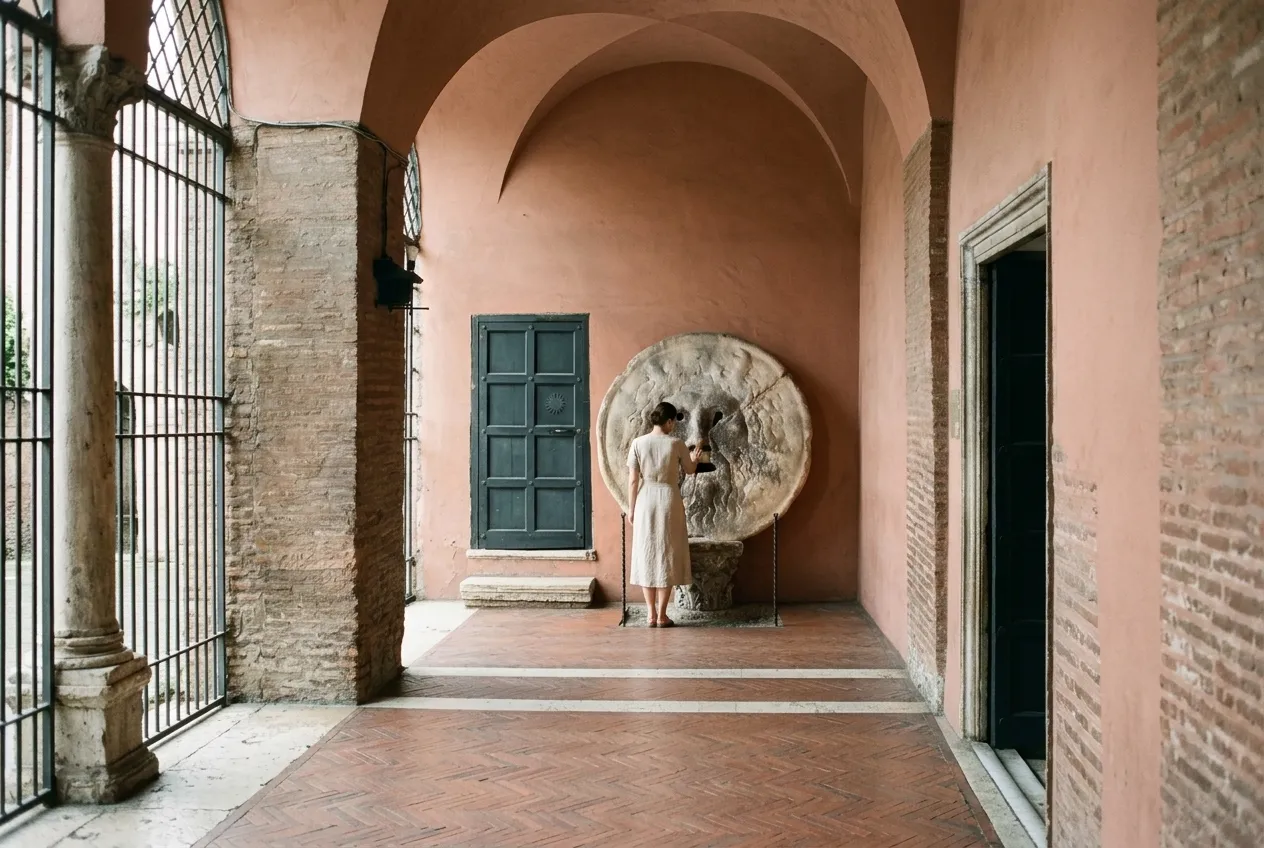
Every morning, before the first coach pulls in, there is a moment when the portico of Santa Maria in Cosmedin is quiet. A round marble face stares out from the wall, 1.75 metres across, worn down by rain, time and several million hands. It is the most photographed drain cover in the world.
What it really is
Nobody carved the Bocca della Verità to tell the truth. It was made in the first century, almost certainly as a drain cover, and the face with the holes for eyes, nose and mouth is most likely a river god or the sea god Oceanus: water ran through him. For centuries it lay around this part of town, which was the old river port and cattle market. In 1632 it was set into the wall of the church portico, and that is where you find it now.
The test
Medieval Rome liked the idea that stone could judge people. The story went like this: put your hand in the mouth and swear. If you lie, the mouth closes and you leave without the hand. Guides, husbands and the odd court used it as a threat for centuries.
The best-known tale is about a Roman wife accused of adultery. She was brought to the Mouth, and she was guilty. But she had a plan. On the way to the test a man broke out of the crowd, embraced her, kissed her and was dragged off as a madman. Then she put her hand in the mouth and swore that no man had ever held her except her husband and “that lunatic a moment ago”. Every word was true. The mouth stayed open and the lover, who was of course the lunatic, went home. In some versions the stone was so offended that it never worked again.
The scream
In 1953 William Wyler shot Roman Holiday here. Gregory Peck put his hand in, pulled it out hidden in his sleeve and pretended the Mouth had taken it. Audrey Hepburn had not been told; the scream you see in the film is the real one, and Wyler kept that take. The queue has never really gone away since.
Around the Mouth
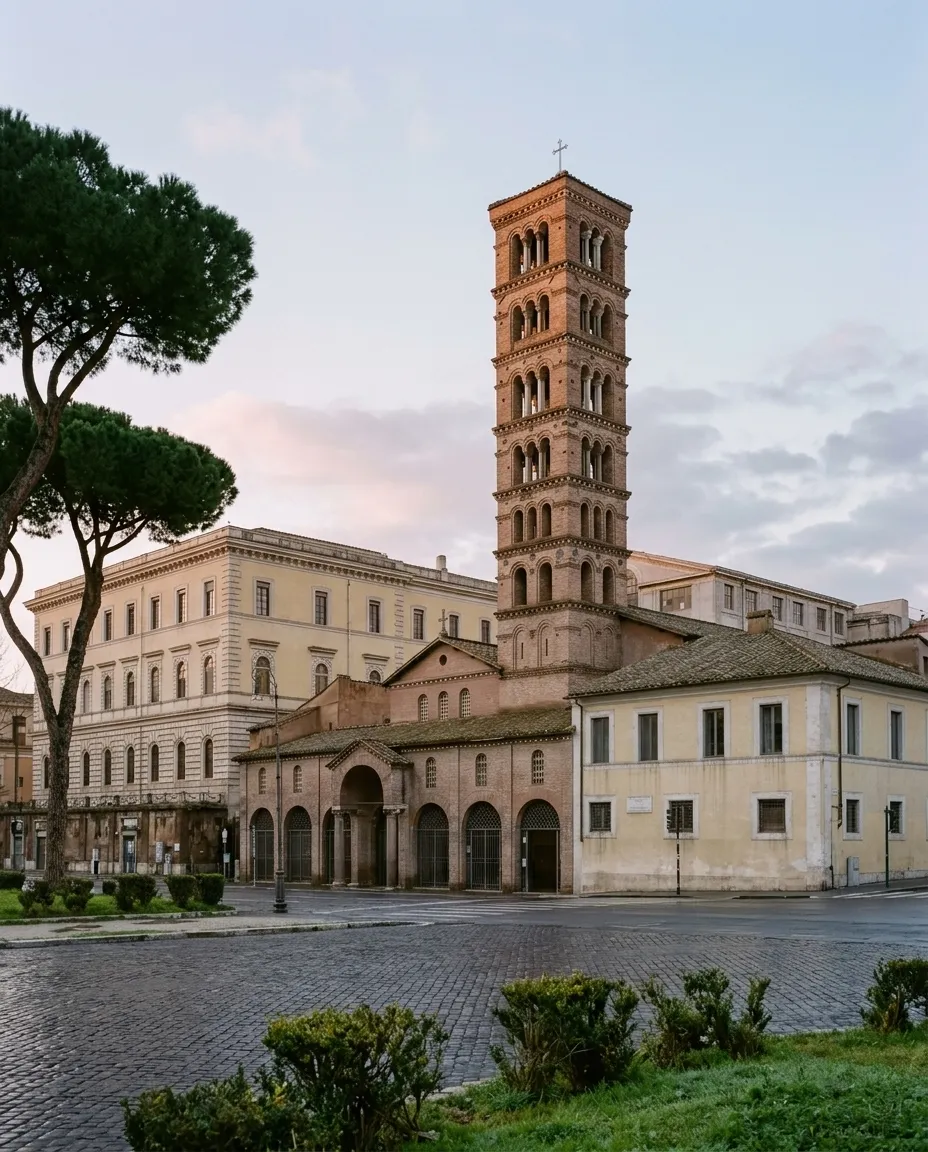
- The church. Santa Maria in Cosmedin is older than the legend: in the 8th century it was given to Greek Christians who had fled Constantinople, and its name comes from a Greek word for “ornament”. The brick bell tower, seven storeys of small arches, is one of the tallest medieval towers in Rome; inside, the floor is a 12th-century Cosmati mosaic. On a side altar, in a glass reliquary, is a skull that tradition links to St Valentine.
- The two temples. Across the square stand two of the best-preserved temples of the Republic: the round Temple of Hercules Victor, the oldest marble building still standing in Rome, and the rectangular Temple of Portunus, god of the harbour. For a long time the round one was called the Temple of Vesta. It never was.
Good to know
- The portico is free. The line can reach 30–40 minutes by late morning; before 9:30 or after 17:00 it is usually short.
- The square sits between the Circus Maximus and the Aventine hill, both on the route of our golf cart tour. If the line is short, ask your driver: a photo takes five minutes.
- Put your hand in with the back facing up. That is how Gregory Peck did it.
See it from the cart
Drive past it with us
This place is on the route of these tours: a stop, a photo and the story told by your driver.